

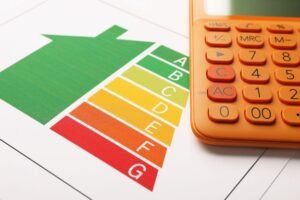
Since January 1, 2025, properties rated G on the Energy Performance Certificate (EPC) have been banned from being rented in mainland France — and properties rated F will follow in 2028. Nearly 600,000 properties are already affected, and for many landlords in the Île-de-France region, this means a complete halt to their rental income. The good news? Getting out of this energy-inefficient status is far from impossible. With the right renovations, done in the right order, improving an EPC rating from G to C is entirely within your reach — and it’s one of the most profitable investments you can make in your property portfolio.
But you have to aim for the right outcome. Not all renovations are created equal, and Parisian architecture imposes its own constraints. To fully grasp the issues, it’s helpful to understand the new Energy Performance Certificate (EPC) and the RE2020 standard. At Parisian Renov, we support homeowners and landlords in the Île-de-France region every day through this transition, from the initial energy audit to the completion of the work. Here, in order of cost-effectiveness, are the renovations that truly improve your property’s energy rating.
In short: how to improve an energy performance certificate (EPC) from G to C
- G-rated properties have been banned from being rented since 2025, F-rated properties will be in 2028: acting now secures your income.
- Insulation is the number one priority: a poorly insulated roof lets up to 30% of the heat escape.
- A comprehensive energy renovation (insulation + heating + ventilation) is more effective and better subsidized than a series of small projects.
- The MaPrimeRénov’, CEE and eco-PTZ grants significantly reduce your out-of-pocket expenses in 2026.
- The new DPE 2026 coefficient reclassifies some housing on paper, but does not replace real work.
What work is needed to upgrade from G to C? The 4 most cost-effective renovations
To improve an energy performance rating from G to C, you generally need to gain three to four classes. This rarely happens with a single action: it’s the coherent combination of four interventions—insulation, heating, ventilation, and windows/doors—that transforms the building’s performance. Here is the order of priority we recommend based on their impact on the rating.
Priority | Works | Impact on the Energy Performance Certificate (EPC) | Key point in Île-de-France |
1 | Insulation (roof, attic, walls) | Very high | Preferred ITI on Haussmannian buildings |
2 | Heating (heat pump) | Pupil | Replaces gas, oil, or energy-inefficient convectors |
3 | Ventilation (double-flow mechanical ventilation) | AVERAGE | Conditioned to insulation since 2026 |
4 | Joinery (double glazing) | Complementary | To be done after insulation |
1. Thermal insulation: the top priority (roof and walls)
This is the most cost-effective area, without a doubt. A leaky building envelope ruins the performance of everything else: there’s no point in installing modern heating in a poorly insulated house. A poorly insulated home loses up to 30% of its heat through the roof, and a significant amount through the walls.
In the Île-de-France region, choosing the right method is crucial. Exterior Thermal Insulation (ETI) is the most effective because it eliminates thermal bridges without reducing living space. However, on Haussmannian buildings, condominiums, and protected facades, it is often prohibited by Parisian urban planning regulations. The solution: high-performance Interior Thermal Insulation (ITI) , perfectly mastered and adapted to the constraints of the capital—a specialty of our renovation company in Paris .
Note: since 2026, wall insulation is no longer funded on its own by MaPrimeRénov’. It must be integrated into a comprehensive renovation — one more reason to think in terms of an overall project.
2. The heating system: make way for the heat pump

Once the building envelope is secured, heating becomes the second most powerful factor influencing your energy rating. Replacing an old gas or oil boiler, or energy-intensive electric convectors, with a heat pump significantly reduces primary energy consumption, the central criterion of the Energy Performance Certificate (EPC).
Air-to-water or air-to-air heat pumps offer excellent efficiency and significantly reduce energy bills. This type of installation is often what moves a home from the red zone to class C or D.
3. Ventilation (MVHR): the essential complement
The more airtight a dwelling is, the more it needs good ventilation to prevent humidity and preserve air quality. This is where a double-flow mechanical ventilation system (MVHR) comes in, recovering heat from the extracted air to preheat the incoming air, resulting in both increased comfort and performance.
Important: since 2026, subsidies for dual-flow mechanical ventilation are conditional upon simultaneous insulation work. Here again, the logic of the overall project must be considered.
4. Windows and doors: double glazing, but as a last resort.
Replacing windows with high-performance double glazing provides an immediate improvement in thermal and acoustic comfort. However, it’s a common mistake to start there: without wall insulation, the impact on the energy performance certificate (EPC) remains limited. Windows and doors should be installed after insulation, to complete an already airtight building envelope.
Funding your grade skipping: energy renovation grants in Île-de-France
In 2026, several programs will be combined to reduce your energy renovation costs. When properly combined, these subsidies often allow the government to finance a large portion of your work . Here are four programs you should know about before starting your project.
Help | What it finances | Good to know in 2026 |
MaPrimeRénov’ Guided Process | Comprehensive renovation (improvement ≥ 2 classes) | Income limits specific to the Île-de-France region; mandatory support |
EEC | Energy saving works | Automatically integrated into the guided tour |
Eco-PTZ | Out-of-pocket expenses after subsidies | Up to €50,000, at zero interest, repayable over 20 years |
VAT at 5.5% | All invoices for work | Direct and immediate discount on the quote |
A key point for both landlords and co-ownership associations : comprehensive energy renovations are now significantly better subsidized than a series of smaller projects. Furthermore, since 2026, several measures (wall insulation, ventilation systems) are no longer eligible for individual funding. Therefore, designing a single, integrated project maximizes your subsidies while ensuring technical consistency.
This is precisely where Parisian Renov makes the difference. Beyond the savings, using qualified professionals prevents costly mistakes: we manage the entire application process for you, optimize your 2026 energy renovation budget, and coordinate RGE-certified tradespeople – an essential condition for unlocking any energy renovation grants.
Beware of the new 2026 Energy Performance Certificate (EPC)
Since January 1, 2026, a new calculation coefficient has reduced the penalty for homes heated with electricity. As a result, hundreds of thousands of men have gained a letter grade without any effort on their part. This is a welcome reprieve, but an improved rating on paper changes nothing about your comfort or your actual bills. A poorly insulated home remains cold and energy-inefficient. To ensure the long-term value of your property, renovation remains essential.
Renovating from G to C: profitability, green value and resale
Moving from G to C is not just about avoiding the ban on renting and the rent freeze. It’s the key to a profitable energy renovation, which benefits three areas: secure rental income, reduced energy bills, and a real increase in property value.
This latter concept has a name: green value. According to notaries, a well-rated property sells on average for 9 to 14% more than an energy-inefficient one—a gap that continues to widen in the Île-de-France region, where the Energy Performance Certificate (EPC) has become a key factor in transactions. When carried out effectively, a property renovation in Paris can thus transform a regulatory constraint into lasting added value.
Don’t let the deadline catch up with you. Contact Parisian Renov today for a comprehensive energy audit and a customized renovation quote in the Île-de-France region. Our experts will assess your property, provide a precise cost estimate for your project, and identify all available financial assistance.
📞 Call us on 06 99 53 69 95 or request your free quote online .
Frequently asked questions: how to change from a G to a C energy performance certificate (EPC) rating.
How much does it cost to renovate from G to C in Île-de-France?
The cost depends on the size and initial condition of the property. For a complete renovation that improves the energy efficiency rating by two to three classes (from G to C), expect to pay between €400 and €1,200 per square meter, depending on the scope of the work. Thanks to government grants like MaPrimeRénov’, this out-of-pocket expense can be significantly reduced. The Parisian Renov team provides customized quotes to accurately estimate the cost of your project.
What work should I start with to quickly improve my energy performance certificate (EPC)?
The number one priority is always insulation (roof, attic, and walls). A poorly insulated home loses up to 30% of its heat through the roof. Once the building envelope is properly insulated, replacing the heating system, for example by installing a heat pump, will have a significant impact on your energy performance certificate (EPC) rating.
Can I rent out my Parisian apartment if it is rated G?
Since January 1, 2025, properties rated G have been banned from being rented in France. Properties rated F will follow in 2028. It is therefore urgent to carry out energy renovation work to eliminate the « energy sieve » status and secure your rental income.
Why should I use Parisian Renov for my energy renovation?
Parisian Renov is a recognized specialist in the Île-de-France region . We offer comprehensive support from start to finish: from the initial energy audit to the completion of the work by RGE-certified tradespeople, including the preparation of your grant applications. We guarantee that the work complies with the requirements of the new Energy Performance Certificate (EPC).
Should you insulate from the inside or the outside in Paris?
Exterior thermal insulation (ETI) is the most effective way to eliminate thermal bridges without sacrificing living space. However, in the Île-de-France region, particularly on Haussmannian or listed buildings, ETI is often prohibited by urban planning regulations. Parisian Renov excels in high-performance interior thermal insulation (ITI), ideal for the constraints of the capital.
Also read on the Parisian Renov blog
- Energy renovation: understanding the EPC and RE2020
- Get 80% of your renovations in France financed by the State
Why hire a professional company for your renovation in 2026?